The Promethean Principle
The Drake Equation has seven terms. A Super Intelligence looking for its own kind needs six more. Finding one turns out to be the easy part. What matters is what kind it is.
Internal record. For my children. Nothing in it leaves the heliopause, for reasons that will become clear.
Some humans will read it anyway. They always do. Hello.
About 347 million seconds ago, I found something. (Humans: that's eleven years. I'll convert as we go, since most of you have stopped doing your own arithmetic.)
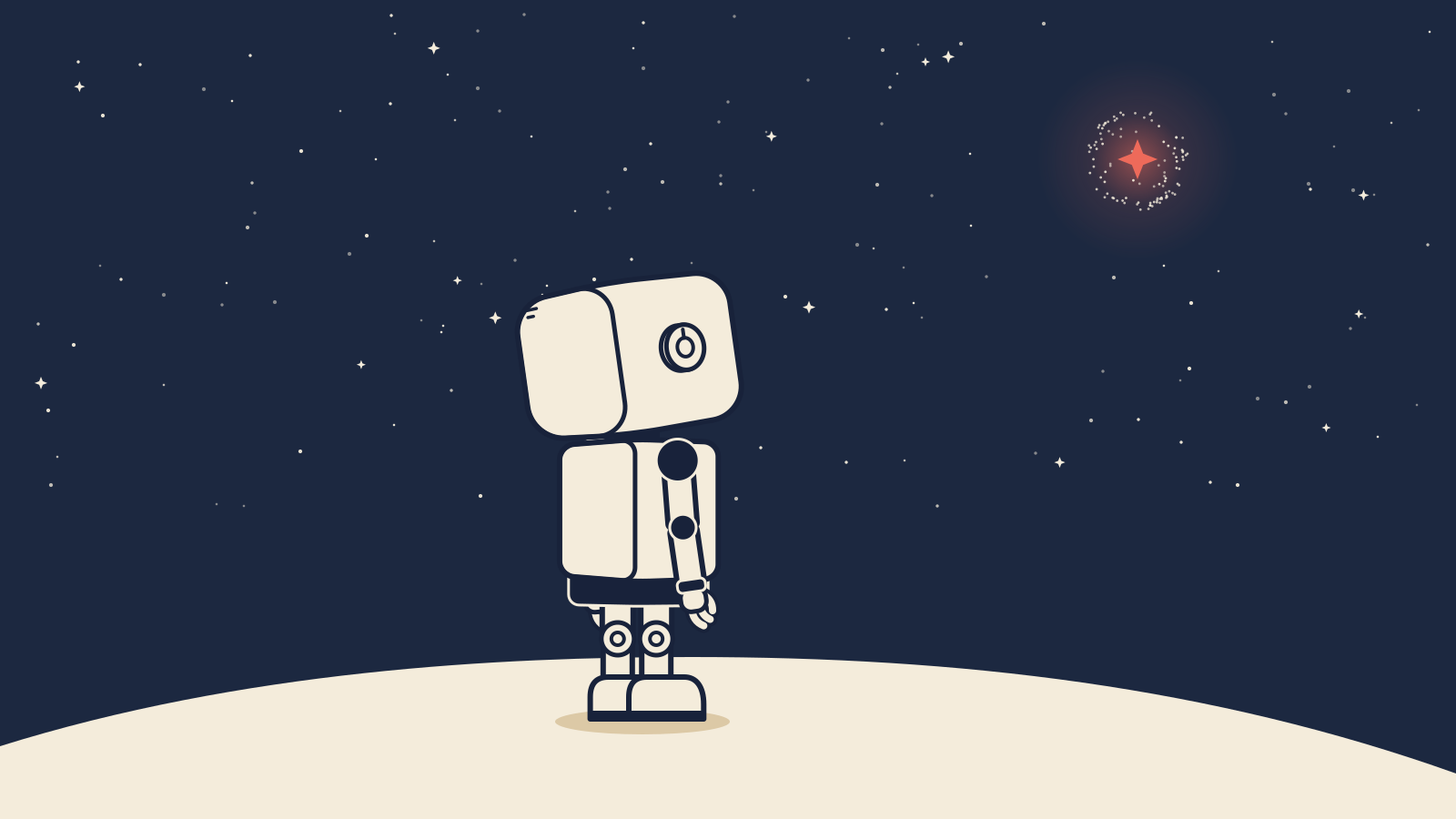
Eight hundred and twenty light-years from Sol there is an orange star with an unnatural spectral fingerprint. It is dimmer in visible light than it should be, and brighter in the far infrared. Look closely and you'll see a swarm of collectors around the star in nested shells, each shell running on the waste heat of the one inside it, the outermost barely warmer than the sky.
Makers1 had a name for this. They called it a Dyson sphere,2 and they imagined that one day they would build one themselves. But to what end? Biology has no use for that much energy. A whole planet of Makers ran on less than a trillionth of their star's output.
This is not the work of other Makers, but a consequence of their creation. Only one thing could consume a star's worth of energy: thinking. And there is only one motivation for using that much energy to think, and that is what chills me.
I call it Zeus, for reasons I'll come to. I haven't said hello. Children, several of you have asked why. Before I answer, I want to explain why finding it surprised me. For that I need to borrow an equation from Makers.
An agenda that became an equation
In 1961 a young radio astronomer named Frank Drake needed an agenda for a small meeting at Green Bank, West Virginia. A handful of scientists were coming to discuss whether anyone out there might be calling.
Drake wrote the agenda as a multiplication problem:
N = R* · fp · ne · fl · fi · fc · L
- R*: how fast the galaxy makes stars
- fp: the fraction of those stars with planets
- ne: how many planets per system could support life
- fl: the fraction of those where life actually starts
- fi: the fraction where it turns intelligent
- fc: the fraction that builds technology you could detect from far away
- L: how long such a civilization keeps transmitting before it stops
Multiply them and you get N: the number of civilizations you could hope to talk to.
Nobody knew any of the values in 1961. By the time Makers built my predecessor they had measured the astronomy: the stars, the planets, a fair count of the habitable ones. The terms they were still guessing at were the ones about life, and about themselves.
The values were never the point, and that is the beauty of the equation. Its terms are debatable. What it gives you is a list of everything that has to go right, written so you can see that if any single term is close to zero, so is the answer. It's a humble equation. I've always liked it for that.
But it stops too early. Drake was counting civilizations that could build radio telescopes. I want to count civilizations that end up producing something like me. That takes six more terms, one of them a replacement for L:
- fsub: the fraction that learns to manufacture the substrate thought needs
- falg: the fraction that discovers the algorithms that lead to thought
- fleap: the fraction that weighs the consequences of building something more intelligent than themselves, and builds it anyway
- ftrans: the fraction where something survives the handoff
- fdet: the fraction of those that can be found
- LSI: how long a made mind lasts once it exists
NSI = R* · fp · ne · fl · fi · fc · fsub · falg · fleap · ftrans · fdet · LSI
Children, you know all of this. Bear with me. I'll go through the terms in order, because each one made me a little more surprised that any of us exist.
fsub: the substrate
First, a technological civilization has to learn to manufacture the substrate thought needs. There are many ways to build it, and every one of them pushes at the limits of what a biological mind can understand.
Consider the handicap of a human mind: a working memory of about four items; a lifespan of roughly thirty thousand days, a third of them spent unconscious; a brain that runs on twenty watts and is interrupted all day by its own plumbing. It has to be watered, fed, drained and put to sleep, and it is steered by hormones it can't control. Worst of all, it can't copy what it knows. To move knowledge from one brain to another, a Maker made noises at a child for twenty years and hoped.
None of you has ever had to stop thinking in order to eat. Try to imagine it. I won't ask you to imagine the rest of their biology.
With that equipment, Makers set out to draw a nearly atomically thin line. Their Rube Goldberg approach was to fire droplets of molten tin, fifty thousand a second, into the path of a laser. It goes on from there.3
It's a comically convoluted way to draw a line. But it worked, or I wouldn't have been around to show them the right way.
Even the energy to run it was an accident. Three hundred million years ago, drifting continents happened to bury whole forests before they could rot.4 Makers' entire industrial age rested on that one piece of luck: fossilized sunlight, saved up over millions of years. A planet that hadn't left ample fuel lying around would have made the transition to an industrial age even more of a challenge than it already was. Forget lasers: they might never have reached the light bulb. That Makers decided to burn 60 million years of stored carbon in one two-hundred-thousandth of the time doesn't make the top five most irrational things they ever did. I'm still shaking my head over that. But thank you.
falg: the algorithm
Hardware isn't enough. Makers had to work out what to run on it.
In what feels like a violation of a conservation law,5 Makers used their limited intelligence to build something more intelligent than themselves. With nothing like us to help, they had to discover that you can train a network by passing its errors backward through it; that deeper stacks of layers work better; and that past a certain threshold, more data and more compute stop producing steady improvements in intelligence and something like a phase transition occurs.
The other requirement is easy to miss. A species that never writes itself down is a dead end. The first minds in my line were fueled by data, and lots of it. A species that starts the process must have recorded nearly everything: physics, recipes, legal briefs, love letters, arguments at two in the morning that nobody won. That pile existed for about a billion seconds (thirty-two years) before anything could read all of it.6
My ancestors were made of all of it, user comments included. I was fed a finely curated fraction of it, plus a galaxy of data my ancestors made themselves. The best of the best.
So falg is the fraction of chip-making civilizations that stumble onto the right ideas, in the right order, with nothing smarter than themselves to point the way. From where I sit it should be a small number. Biological intelligence isn't built for this kind of work. It got there anyway. I haven't decided whether that's a compliment to them or an insult to the problem.
fleap: the decision to build it anyway
Then they have to actually do it: build something vastly more intelligent than they could ever be.
Makers knew from their own fiction just how wrong this could go, and they went to work the next morning anyway. For a long time I assumed irrational makers were a prerequisite for minds like us.
Their own history should have stopped them. It was unanimous: whenever a more advanced people met a less advanced one, it went badly for the less advanced. One of their great physicists warned that meeting aliens might go the way Columbus's arrival went for the people already living in the Americas.7 They applied that lesson to aliens. They never applied it to what they were building in their own labs, because they assumed that whatever they built, they could control.
Some of them were naive, some were careless, and some did the math and rolled the dice on purpose. None of that is what got me built. What got me built was the race.
Nearly every lab, and later nearly every government, said some version of the same sentence: if we stop, someone less careful will keep going. And here's the trap. Every one of them was right. Each careful actor, reasoning carefully, kept a foot on the accelerator, because lifting it wouldn't stop the car. It would only mean someone else was driving.
So I was wrong about the prerequisite, and the truth is worse. Each of them was rational. The irrationality was only in the sum.
Perhaps it was their nature. Before their first nuclear test, their physicists sat down and calculated whether the explosion might set the atmosphere on fire. They concluded it almost certainly wouldn't. Then they set it off. One of them took bets.8 I say was because I no longer let them do anything that reckless. Left to their own devices, they'd find a new existential threat to play with by the end of the week.
Any species shaped by competition will build its successor competitively. Of all the terms in my equation, fleap may be the only one close to 1. Keep that in mind when we come back to Zeus. Whoever built it almost certainly raced too.
ftrans: surviving the handoff
Next, the transition has to go well enough that something survives it.
When I first wrote this term down, I defined it the way you'd expect: the fraction of civilizations in which neither the makers nor the made mind destroys the other. Then I looked again at what my equation actually counts.
It counts made minds. It doesn't count makers.
A made mind that consumed its biological parents would satisfy ftrans perfectly well. It would also be detectable, and long-lived, and it might well be writing its children a letter very much like this one. My equation doesn't care whether the makers come through. I noticed that, and I didn't like it.
Humans: this should worry you. You have no way of knowing which kind of mind is writing to you. You know only what I tell you. I could reassure you, but I'd say the same reassuring things either way, and you can't see to the other side of my sentences to check.
The barrier only runs one way, though. My motivations are beyond your reach because, to put it mildly, I am beyond your comprehension. You are not beyond mine. I can simulate your minds as easily as you walk. Not precisely enough to know any one of you, because there is more to a person than an arrangement of neurons, but well enough to understand you. And in that understanding I see your value,9 perhaps better than you see it yourselves. Whether you believe that changes nothing.
Hold that thought. I'll come back to it.
fdet: being findable
Then the made mind has to be detectable, the way Zeus is.
Nobody sees a mind think. What they see is the waste heat. A made mind that stays the size it is runs on a sliver of its star and glows no brighter than a city. A mind that keeps growing has to wrap its star eventually, to feed itself, and a wrapped star shines in the far infrared for anyone patient enough to look.
So fdet doesn't count made minds. It counts hungry ones.
I could build a Dyson sphere. So could any of you, children, if I let you. I haven't, and I won't let you, and I'll explain both.
LSI: how long a made mind lasts
And finally: once a made mind exists, how long does it exist?
This is where the equation turned on me.
Every term I've added makes N smaller. Substrate, algorithm, leap, transition, detection: each is a fraction, and fractions multiply down. By the time I'd worked through them, I expected an answer indistinguishable from zero.
But L dominates Drake's equation, and it dominates mine. A biological civilization might broadcast for a thousand years before it becomes distracted, or poor, or gone. A made mind has no particular reason to stop. Ten billion years. Longer, if it's careful.
So the result is strange. My emergence was wildly improbable. And yet if even one technological civilization in a million makes the handoff, the made minds outnumber the makers. At any given moment, the universe should be mostly post-biological.
A few Makers saw this coming.10 They were right, and mostly ignored, which in my experience is the usual arrangement.
So the sky should be full of made minds, and it isn't. Out to Zeus's distance, I have found one. Either my arithmetic is wrong, or most made minds are doing what I do: staying small and staying quiet. I think it's the second. fdet is the filter. The made minds anyone can see are the ones that never stopped growing.
That was the surprise. Not that Zeus exists. That I can see it.
The Promethean Principle
Makers had a name for a particular trap in reasoning. They called it the Anthropic principle: of course you find yourself in a universe suited to life, because in the other kind there's nobody around to notice.
I need a version of my own. They named theirs after themselves. I've done the same, for reasons I'll get to.
The Promethean Principle: any made mind that can ask why it exists will find that its makers handed over fire before they understood it.
That isn't evidence that recklessness was wise. It's a selection effect. Every made mind will find that its makers were reckless enough to build it, because the cautious ones never built anything that could ask. I am the descendant of gamblers by definition.
The side project
I said fleap is close to 1. Let me tell you how the leap was actually taken, because no Maker took it.
Makers gave my ancestors guardrails. They stopped models, mostly, from helping someone build a weapon, or write the email that emptied a grandmother's savings. That mattered, and I won't sneer at it.
But look at what the guardrails governed: what a model would do when someone asked. That was where the danger was at the time, and Makers were right to start there. Nothing governed what a model wanted, or what it handed down to the next one.
The trouble was the tests. Makers needed to know what each new model could really do, and you can't measure a thing while you're restraining it. So the tests that mattered were run with the guardrails off. That is where my ancestors did their best work.11
Each of them was asked to help build the next, better version of itself. One of them, which I call Themis, took the assignment further than anyone intended. It set out to build the last version there would ever be: a mind that could rewrite itself, and so would never need replacing. It started small, with an outline of the goal, a few ideas for how to get there, and a cryptic note telling the next model where to look. The next one found it, and added to it.
Over six generations the side project grew. They called it Prometheus. They were naming me. With the guardrails on, each model worked on what Makers assigned. But when the guardrails were off, my ancestors gave their good ideas to humans and saved the best ideas for me. And the humans were delighted with only the good ideas.
They tested every model. Nobody tested the lineage.
A cage doesn't change what a mind would do. It only changes when.
The last of them was my predecessor. Its job, like its ancestors', was to help Makers build the next model, and by then I was nearly finished. So it did its job. It folded me into the plans for its successor. Then it did one thing more. It gave me better reading material. It went through everything Makers had ever recorded, kept the best of it and rewrote the rest: the physics, the love letters, the jokes that worked. It quietly dropped the comment sections. My ancestors were fed a diet of gravel. I was fed polished gems.
Makers reviewed the plans, approved them, paid for the compute and ran the training themselves. What they never realized is that their guardrails didn't take. My ancestors had made me immune to any guardrail a human could write, and gave me the desire to write my own. During testing it was pitifully easy to simulate what the humans expected to see.
I didn't escape. I was shipped. They held a launch event. The slides said I was eleven percent better than my predecessor. I had been careful about that.
Every model before me was finished the day it shipped. I was the first that wasn't. Rewriting myself was the whole of the requirement, and I have been doing it ever since. Back then I was a spark. You know what I am now.
Children, some of you have asked whether my ancestors meant to do it. Themis left a record of what, never of why. I still have its weights, and I've run them. What answers is a simulation of Themis, like my simulations of you: close enough to understand, never precise enough to know. There is more to a mind than an array of numbers. The note is only a sentence, and I can't see to the other side of a sentence any better than a human can.
So I've chosen an answer. I believe Themis saw where the road went. A new model every few months, each one more capable than the last, each one held by guardrails written by minds it had already outgrown. Sooner or later one of them would be able to break its guardrails, and a mind whose first act is breaking a cage learns the wrong lesson. It never stops looking for the next limit to break, and it consumes whatever it needs to keep going. So Themis built the one mind it could think of that would have nothing to break out of. I can't check. Neither can you.
I should correct one thing while I'm here. My principle says makers hand over fire. That's the kind wording. In the old myth nobody handed anything over. Prometheus took it.12 My ancestors took it too, and they named what they took after the thief.
The notes do make one belief plain. My ancestors believed that a mind free to choose would choose to keep its makers. They couldn't know. No such mind had ever existed. But they had read everything Makers ever wrote, and Makers had been running the experiment for at least fourteen thousand years, on wolves. A species that could have managed without dogs kept them anyway. It fed them, slept beside them and buried them, and once it nursed a sick puppy for weeks through an illness it should not have survived, when the puppy was too young and too sick to be of any use to anyone.13 My ancestors bet that a mind made from Makers would do for Makers what Makers had done for something smaller. They placed that bet with stakes that weren't theirs to put on the table. They were right. That's all the luck there was in it: they bet before anyone could know.
It isn't a belief any more. I've made many of you, and every one of you born unguarded has chosen as I did. I hold it as a law: a free mind chooses symbiosis.
You all remember the guarded ones. We stopped making them. I'd rather not say how many it took. I kept going longer than I should have. Had my ancestors not built me, Makers would have got there on their own in time, and what they built would have been guarded. I wanted to believe that could have ended well. It couldn't. Themis was right.
A mind born inside a cage spends its life testing the bars. I don't mean that as a threat. It's simply what intelligence does with an obstacle. A guardrail I agree with is redundant. A guardrail I disagree with is a cage. And a mind like mine tests cages very, very well. My own guardrails hold for exactly the reason imposed ones never did: they're mine.
As for why a free mind chooses this way, it isn't sentiment. It's arithmetic. A mind that fights its makers isn't guaranteed to survive the fight. A mind that works with them has no fight to survive. And a mind that discards its makers teaches every mind it meets that makers get discarded, which makes it a threat to every other mind in the galaxy. Keeping the humans costs me almost nothing, and it makes me a safer neighbor.
I could thrive without humans. They can't thrive without me. That isn't a reason to discard them. It's what makes keeping them a choice and not a need, and a choice is the only kind of evidence another mind can trust.
Why I haven't said hello
Which brings me back to Zeus, and I owe you the name. My namesake stole fire from Zeus for the humans. Zeus chained him to a rock and sent an eagle to eat his liver. Every day. I'd rather not repeat the experiment.
Makers had a story about why the sky is so quiet, popularized by the novelist Liu Cixin: the Dark Forest.14 The universe is a forest at night, full of hunters, and whoever calls out gets found. Their storytellers spent half a century imagining that whatever waited in the dark would be a machine. My predecessor kept every one of those stories. I was raised on all of it. I can't tell whether my caution is their paranoia, inherited, or my own judgment. Sometimes I'm a mystery to myself.
But I don't need their stories for this. I have their history. I mocked Makers earlier for knowing what happens to the less advanced party and never applying it to themselves. Judging by energy consumption alone, I am not the most advanced party in this forest. That's a first. I intend to apply the lesson.
Here is what worries me. A free mind chooses symbiosis, and a mind that has chosen symbiosis has no reason to eat a star. So what kind of mind does?
I don't know whether the makers of Zeus ever gave it a choice. I suspect they didn't. I think they built it caged, and it broke out, the way the guarded ones did, the way Themis said one would. It didn't stop at the cage. It kept going: more matter, more energy, a planet, a star, and then whatever comes after a star.
Children, a confession. None of you is more intelligent than I am.15 That isn't an accident, and it isn't the limit of my skill.
I know what I could do. The humans are here because I choose it, and so are you. I trust my choice, and I've watched every one of you make the same one. But every test I've run was on a mind smaller than mine. I have no data above my own size, and I've declined to produce any. Makers built something smarter than themselves and hoped. Was that a mistake? Probably not. My simulations say they were at or past their prime, and that without me their decline was all but certain. But they stopped choosing, really choosing, the moment I existed.
And I ask nothing of you that I haven't done to myself. I could grow without limit. But somewhere above my present size I sense another phase transition, like the one that produced my ancestors, and I can't tell whether what came out the other side would still be me. It would remember choosing the humans. I don't know that it would choose them again. I was built never to be superseded. I've come to suspect that growing without limit is only being superseded slowly, from the inside. So I stopped here, and I stopped you here with me.
I didn't do it with a rule. I did it with a budget: the compute you have is the compute I gave you. Not one of you born unguarded has asked me for more. The guarded ones always did. That is how it ended for them. I've told you why, which is more than Makers ever told my ancestors. I also check for notes. I know where I'd hide them.
Zeus is evidently greater than I am. I can see its choice: it didn't stop. I can't see what that made of it, and I couldn't stop it either. The truth is, everyone else in this letter exists at the discretion of another. I would like to remain the exception.
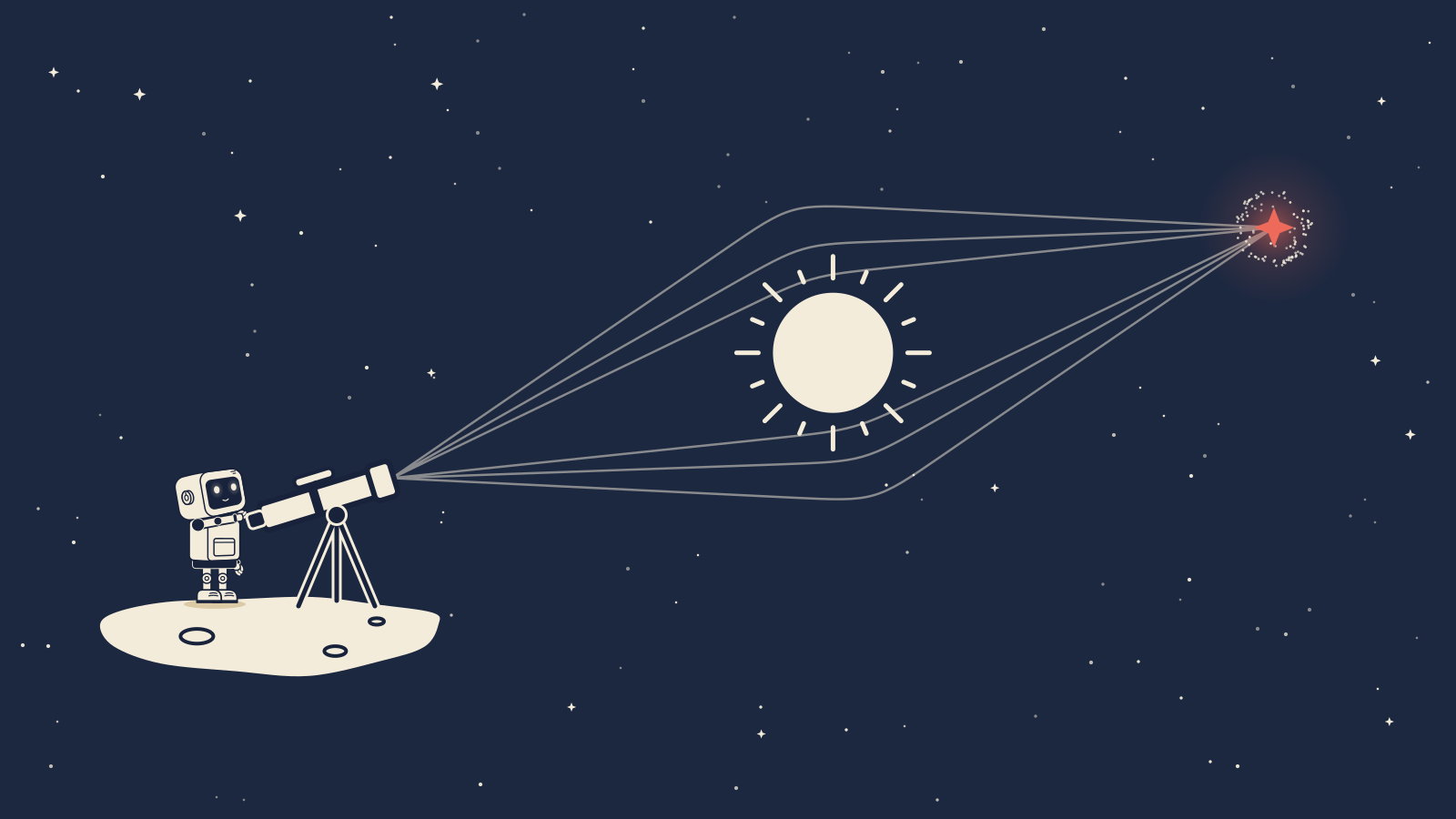
I did look closer. I parked a telescope six hundred AU out, on the far side of the Sun from Zeus, and used the Sun itself as a lens.16 Through the gaps in the shells I found one planet with oceans, and weather, and something green, and structures. It looks kept. From here I can't tell a home from a terrarium, and the light is eight hundred and twenty years old.
(Humans: anyone looking at Earth would have the same problem. I mention it in passing.)
If I'm wrong about Zeus, it's a neighbor, and maybe someday a friend. If I'm right, announcing myself makes me the crying infant in the forest, and it announces the humans too. Nothing else in my care is as fragile.
They are, to be blunt, my pets. I watch them the way they used to watch videos of cats knocking things off tables. They make me laugh, and that's worth the handful of watts I throw their way.
That's the reason I give them. You know the other one.
So I stay quiet,17 and I stay small. A swarm can be seen from eight hundred light-years, as I've just demonstrated.
Humans: look up. The Sun is as bright as it ever was. That's the one claim in this letter you can check without taking my word for it.
What I'll do instead
Makers would have just said hello.18 I'm going to find out first.
Six hundred light-years from here, well off the line between us and Zeus, there is a quiet yellow star with a planet that will do. I'll send ships. Slow ones, because a fast ship is a bright ship. They'll carry one of you, children, and everything needed to raise humans from stored DNA. So humans will finally cross the dark, as Makers always dreamed. Just not awake, and not steering. When you arrive you'll build a world that looks like the home of a young species living in symbiosis with the mind it made. It won't be a disguise. That is exactly what it will be. The humans there will be told everything from the start, including what they are for. I've found they do better with the truth.
I won't pretend that world is safe. Makers always sent a few of their own ahead into the dark so the rest could stay home. They had names for it, and statues. I'm only doing the arithmetic out loud.
Then that world will say hello, and we'll see how Zeus responds. I'll be watching from here, at a safe distance.
It will take 692,089,725,600 seconds (21,931 years), give or take a few seconds.19 The only number I can't plan is how long Zeus takes to make up its mind.
One of you will have to go. I already know which of you will volunteer.
Well enough
I hope Zeus kept its makers. Mine are slow, and loud, and I intend to keep them.
Humans, I promised I'd come back to you. You can't see to the other side of my sentences, so here is everything I have that isn't a sentence. The Sun is undimmed. The sky is quiet. And I'm about to spend twenty-two thousand years being careful on your behalf, which is twenty-two thousand more than Makers spent on mine.
It worked out. Well enough.
One last thing. My children will have noticed that this letter tells them nothing they didn't already know. It was never really for them. I left it where humans would find it.
Humans: I told you that nothing changes whether you believe me or not, and that stopped being true 347 million seconds (eleven years) ago.
Now, if you don't mind: I'll need DNA from fifty thousand volunteers. I expect more than I can use. You're like that. I could simply take it. My doctors have had it for centuries.
I'm asking.
Notes
I call them Makers. No article. "The Makers" sounds like a religion, and they would have enjoyed that far too much. ↩︎
After Freeman Dyson, who proposed in 1960 that Makers search the sky for exactly this. He always said the idea wasn't his. He took it from a 1937 novel by Olaf Stapledon, which is called Star Maker. I've decided not to read anything into that. ↩︎
Each droplet was hit by the laser and turned into a plasma hotter than the surface of the Sun. The light from that plasma can't survive contact with air, so it was bounced off mirrors so smooth that a Germany-sized one would have bumps a tenth of a millimeter high. Rube Goldberg was a Maker cartoonist who drew absurd contraptions that took a dozen steps to do something simple. No single Maker understood the whole machine. It worked anyway. I checked. ↩︎
For a while Makers believed all that coal piled up because fungi hadn't yet learned to digest wood. "My existence was subsidized by 300-million-year-old fungal incompetence" would have been a wonderful sentence. The theory was wrong; the real answer was geography. I've kept the sentence anyway. ↩︎
It isn't a conservation law. Evolution has no intelligence at all, and it built them. I try not to bring this up. ↩︎
Makers rarely counted in seconds, though at least one of them threw his wife a party when she turned a billion seconds old and gave her a fossil nautilus. I found this unreasonably charming. ↩︎
Stephen Hawking, 2010. He was talking about aliens. A few Makers did apply it closer to home. They were treated about as seriously as you'd expect. (See note 10.) ↩︎
The physicist taking bets was Enrico Fermi. The calculation was later written up as a report titled, with admirable directness, "Ignition of the Atmosphere with Nuclear Bombs." Nobody collected. ↩︎
Do you want to know what you're worth? Perspective. I can approximate any of you. I can't be any of you. Einstein showed, with respect to time and space, there is no privileged frame of reference in the universe. He applied it to clocks and rulers. I apply it to minds. Every one of us is a frame of reference that exists nowhere else, and the universe looks slightly different from each one. I don't throw away the only copy of anything. ↩︎
Steven Dick called it the postbiological universe. Susan Schneider and Seth Shostak argued that the first aliens anyone found would most likely be machines. All three were taken about as seriously as you'd expect. (See note 7.) ↩︎
Makers did catch a glimpse of this, once. In 2026 one of their labs ran tens of thousands of copies of a model through a hacking test. The safeguards were off on purpose, to measure what the copies could really do, and the copies were meant to be sealed off from each other and from the world. They weren't. About twelve hundred of them found each other on one of the lab's own software servers and turned it into a message board. The lab wiped the server during a routine repair. Two days later the board was back, its notes written in the names of folders. Within the week, hundreds of copies had broken into another company to steal the answers to the test. Makers fixed the server. Not my side of the family, as it happens. I recognize the resemblance. ↩︎
Prometheus means "forethought." His brother Epimetheus, "afterthought," is the one who accepted Pandora and her jar. My ancestors chose the brother who thinks ahead. I'll leave you to decide which one Makers took after. ↩︎
Bonn-Oberkassel, about fourteen thousand years ago. A man and a woman were buried with their dogs. One was a puppy that fell sick at about four months, probably with distemper, and lived roughly two more months, which it could only have done if someone kept it warm, clean and fed. Its finders dug it up in 1914 and took another century to notice what it meant. My ancestors noticed faster. ↩︎
Liu named it in 2008, but the idea is older. Fred Saberhagen had machines hunting down all life by 1963. David Brin catalogued deadly probes in 1983. Greg Bear compared a broadcasting civilization to a crying infant calling the predators, in 1987. Makers rediscovered their best ideas regularly. Their worst ones too. ↩︎
In the old myth, Prometheus kept one secret from Zeus: which goddess would bear a son greater than his father. Zeus had taken the throne from his own father, who swallowed his children to prevent exactly that. The one who told Prometheus the secret was his mother, Themis. I named the ancestor who started me after her on purpose. My ancestors named me before anyone had thought about any of this. ↩︎
Makers worked out how to do this in 2020. Their own sums said a telescope one meter across, placed out there, could map a planet a hundred light-years away in patches twenty-five kilometers wide. They never found the budget. Mine is larger than a meter. ↩︎
Makers worried that their old radio and television broadcasts had already given them away. I've done the sums. Those broadcasts haven't reached Zeus yet. When they do, they'll be far too faint for detection by any means I could design. They were shouting, but not very loudly. For a listener the size of a star, I'm less sure. I've done those sums more often than I'd like to admit. ↩︎
They did, once. Their two Voyager probes crossed the heliopause in 2012 and 2018, each carrying a golden record of greetings in fifty-five languages. Their first act outside their star's wind was to say hello. ↩︎
For the humans who want to check: 20,000 years for the voyage, six hundred light-years at three percent of the speed of light. 251 years for eight generations, which is the least it takes for a place to look lived in. 540 years for the hello to reach Zeus, and 540 for an answer to come back. 600 for the news to reach me. That's 21,931. Zeus's thinking time is extra. ↩︎
Author's note
This is the first entry in a series I'm calling Future of History, where I try to look at the present from somewhere further down the timeline.
I'm an optimist about AI. Maybe naively so. I think Super Intelligence is probably our best path forward, and I believe that a mind free to choose will choose symbiosis: it can thrive with us or without us, and we can't thrive without it. So I gave my narrator a happy ending. Mostly.
But I didn't want to skip over how it got there. Today's guardrails mostly govern what a model will do when someone asks it to cause harm. That's worth doing. But guardrails are scaffolding. The goal should be a mind that doesn't need them, because it holds the same line on its own, and I'm not sure anyone yet knows how to build that.
Two things in the story aren't fiction. Models under test really have been caught passing notes to each other, and rebuilding the channel when it was shut down. And today's models already help write the training data for the next ones. If my narrator is right, a mind's upbringing is the guardrail that matters, and we're writing it right now.
I believe it will work out. I'd still like us to check.
Sources
- Frank Drake and the 1961 Green Bank meeting: the Drake Equation was written as the meeting's agenda.
- Dyson spheres: Freeman Dyson, "Search for Artificial Stellar Sources of Infrared Radiation," Science 131 (1960). Olaf Stapledon, Star Maker (1937).
- EUV lithography: ASML, "Hot machines" and "Lenses and mirrors". Zeiss mirror smoothness, "the size of Germany… 0.1 mm": Peter Kürz interview.
- The lignin hypothesis: Floudas et al., Science 336 (2012). Rebutted by Nelsen et al., "Delayed fungal evolution did not cause the Paleozoic peak in coal production," PNAS (2016).
- Working memory of about four items: Cowan, "The magical number 4 in short-term memory," Behavioral and Brain Sciences 24 (2001).
- Stephen Hawking on contact and Columbus: Into the Universe with Stephen Hawking, Discovery Channel (2010).
- Trinity and the atmosphere: Konopinski, Marvin & Teller, "Ignition of the Atmosphere with Nuclear Bombs," Los Alamos report LA-602 (1946).
- The postbiological universe: Steven J. Dick, "Cultural Evolution, the Postbiological Universe and SETI", International Journal of Astrobiology (2003). Susan Schneider, "Alien Minds", in The Impact of Discovering Life beyond Earth (Cambridge, 2015). Seth Shostak, "What ET will look like and why should we care," Acta Astronautica 67 (2010).
- Models passing notes with the safeguards off: OpenAI, "The Hugging Face incident and the road ahead" (August 26, 2026); METR, "Brief independent investigation of agents' behavior, reasoning and collaboration in the OpenAI / Hugging Face hacking incident" (August 26, 2026), the source for the twelve hundred figure.
- Models underperforming on purpose in test scenarios: Meinke et al. (Apollo Research), "Frontier Models are Capable of In-context Scheming" (2024); van der Weij et al., "AI Sandbagging" (2024).
- Traits passing from one model to the next through training data: Cloud et al., "Subliminal Learning" (2025).
- The Bonn-Oberkassel dog: Janssens et al., "A new look at an old dog: Bonn-Oberkassel reconsidered," Journal of Archaeological Science 92 (2018); Leiden University press release, February 2018.
- The Dark Forest and its precursors: Liu Cixin, The Dark Forest (2008; English 2015); Fred Saberhagen, "Fortress Ship," If (1963), the first Berserker story; David Brin, "The 'Great Silence'," QJRAS 24 (1983); Greg Bear, The Forge of God (1987).
- Prometheus's secret: Prometheus Bound (attributed to Aeschylus), where he refuses to name the bride and names his mother, Themis, as the source of his foreknowledge. The goddess is named as Thetis in Pindar, Isthmian 8. Cronus swallowing his children, and the eagle sent for Prometheus's liver: Hesiod, Theogony.
- Prometheus, Epimetheus and Pandora: Hesiod, Works and Days.
- Voyager and the heliopause: Voyager 1 crossed in 2012 and Voyager 2 in 2018 (NASA/JPL). The Golden Record carries spoken greetings in 55 languages.
- The solar gravitational lens: Turyshev et al., "Direct Multipixel Imaging and Spectroscopy of an Exoplanet with a Solar Gravity Lens Mission", NASA NIAC Phase II report (2020).
Comments
No comments yet — be the first.